How to Make a Complaint About a Business Energy Broker: A 2026 Guide

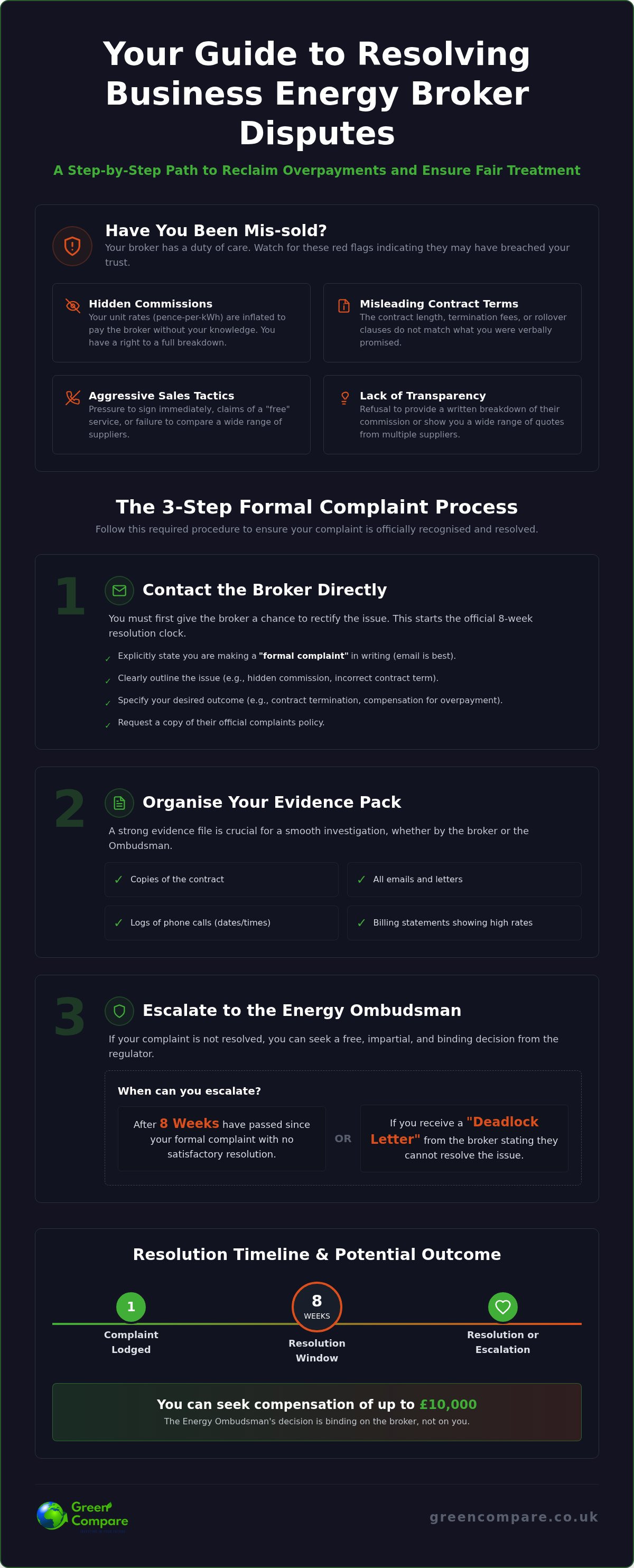
What if that "competitive" energy rate you signed for actually includes thousands of pounds in hidden commissions you never authorised? Finding out your broker used aggressive tactics or misleading terms to lock you into an unfair contract is more than a nuisance; it's a direct hit to your bottom line. You aren't alone in feeling that your trust was misplaced. Understanding how to make a complaint about a business energy broker is the first step toward restoring financial transparency and securing the growth your company deserves.
We're here to help you turn that frustration into a strategic advantage. This definitive 2026 guide provides a clear, step-by-step path to resolve disputes and reclaim what's yours. We agree that your focus should be on your business's future, not on unravelling complex utility disputes. You'll learn exactly how to navigate the 8-week resolution window, when to involve the Energy Ombudsman, and how to seek compensation of up to £10,000. Let's move your company from a position of uncertainty to one of absolute control.
Key Takeaways
- Identify signs of mis-selling, such as hidden commissions or aggressive tactics, to determine if your broker has breached their duty of care.
- Follow our streamlined 3-step guide on how to make a complaint about a business energy broker to ensure your dispute is formally recognised and tracked.
- Organise a robust evidence pack, including call logs and contract copies, to simplify the investigation process for the Energy Ombudsman.
- Understand the 8-week resolution deadline and learn how to secure a deadlock letter to fast-track your path to financial compensation.
- Discover how to transition to a transparent procurement model that protects your business from unfair contracts and future overhead spikes.
Identifying Mis-selling and Common Energy Broker Disputes
To understand What is a Business Energy Broker?, you first need to recognise their role as a Third Party Intermediary (TPI). They don't provide your business gas or electricity directly; instead, they act as a bridge between your company and the energy suppliers. This position carries a significant duty of care. Brokers are professionally obligated to provide honest, accurate, and transparent advice that serves your best interests. When a broker puts their own commission ahead of your savings, they've breached that trust.
Mis-selling in the commercial energy sector is often subtle. It might involve a broker glossing over certain fees or failing to mention that they only compared a small handful of suppliers. In any dispute, it's vital to distinguish between the supplier who sends your bills and the broker who arranged the deal. If your grievance is about the sales process, the price structure, or the advice you received, your target is the broker. By 2026, regulatory standards have sharpened, making it a legal requirement for brokers to be entirely transparent about their fees and incentives. If they've kept you in the dark, you have solid grounds to learn how to make a complaint about a business energy broker.
Hidden Commissions and Fee Disclosure Rules
For years, many brokers operated on a "hidden" commission model, where their payment was added as a secret uplift to your pence-per-kWh rate. This practice is now under intense scrutiny. You have an absolute right to request a full, written breakdown of exactly how much a broker earned from your contract. Red flags include claims that their service is "free" or a refusal to show you a wide range of market quotes. If your unit rates seem unusually high compared to the market average, it's likely that a substantial commission is inflating your bills. Demand clarity; it's the first step in reclaiming your overpayments.
Misleading Contract Terms and Rollover Rates
Aggressive sales tactics often involve "verbal" contracts where the full terms and conditions are never clearly explained. You might have been told you were signing a two-year deal, only to find yourself locked in for five. Brokers may also fail to disclose rollover clauses that automatically renew your contract at significantly higher rates if you don't cancel within a narrow window. These tactics are designed to trap your business in expensive cycles that drain your capital. Spotting these issues involves reviewing your original correspondence and comparing it to your current billing reality:
- Check if the contract length matches what you were promised over the phone.
- Identify any "termination fees" that weren't clearly highlighted during the sale.
- Look for automatic renewal dates that were never brought to your attention.
Understanding these common pitfalls empowers you to build a robust case. When you know exactly how you were misled, knowing how to make a complaint about a business energy broker becomes a straightforward process of asserting your rights.
The 3-Step Process to Lodge a Formal Complaint
Resolving a dispute with a Third Party Intermediary (TPI) requires a methodical, professional approach. You cannot leapfrog straight to a regulator; you must first give the broker a fair chance to rectify the situation. This isn't just a courtesy. It's a mandatory step in the process of how to make a complaint about a business energy broker. Ensuring your grievance is 'formally' recognised is the cornerstone of your strategy. Simply venting to an account manager isn't enough. You must explicitly state that you are making a "formal complaint" to trigger their internal regulatory obligations. This forces the broker to follow their documented procedures and starts the clock on the 8-week resolution window.
Maintain a meticulous timeline from the very start. Record the date of every email, the name of every representative you speak with, and a summary of their responses. This log acts as your evidence base if the situation escalates. Transition every grievance into a formal, written "Letter of Complaint" to ensure your concerns are logged within their official system. If you're tired of the lack of transparency, you might find that switching to an honest energy comparison service prevents these headaches from happening in the first place.
Step 1: Contacting the Broker Directly
Request the broker's formal complaints policy immediately. They are required by law to provide this document upon request. When you write your letter, be direct and pragmatic. State exactly what went wrong, whether it was a hidden fee or a misleading contract length, and specify your desired outcome. Use direct imperatives to demand an initial response within 10 working days. This sets a professional pace and demonstrates that you are serious about a resolution. Avoid vague language; clear, concise points are much harder for a broker to ignore.
Step 2: Escalating to the Energy Ombudsman
The transition from a broker's internal process to the Energy Ombudsman is a critical junction. If the broker fails to resolve your issue within 8 weeks, or if they send a "deadlock letter" stating they won't take further action, you can escalate immediately. The Energy Ombudsman provides a free, impartial service for eligible small businesses. Under the new Ofgem rules, protections have been significantly strengthened for microbusinesses. To qualify, your firm must typically have fewer than 50 employees and an annual turnover of no more than £6.5 million.
The Ombudsman acts as an impartial adjudicator for UK firms, possessing the power to order the broker to take practical action, provide a formal apology, or even pay financial compensation of up to £10,000. You have one year from receiving a deadlock letter to bring your case forward. Their decision is binding on the broker once you accept it, and the firm has 28 days to implement the remedy. This structured timeline ensures that your pursuit of justice doesn't drag on, allowing you to return your focus to scaling your business.
Gathering Evidence to Build a Robust Case
Evidence is the engine of your claim. Without a clear audit trail, your grievance remains a matter of opinion rather than a proven breach of duty. When you learn how to make a complaint about a business energy broker, you quickly realise that the Energy Ombudsman relies on documented facts to reach a binding decision. An organised evidence pack doesn't just strengthen your position; it accelerates the entire resolution process. Treat this stage as a strategic audit of your broker’s behaviour, designed to restore the financial transparency your company deserves.
A well-structured case file shows the broker you mean business. It also saves the Ombudsman hours of administrative sorting, which can lead to a faster ruling. Use a simple digital folder to keep everything in one place. Your goal is to create a linear narrative of the broker's failure to meet their professional standards. This level of proficiency reflects your commitment to shared progress and ethical business practices.
Essential Documentation: Bills, Emails, and Recordings
Collate every copy of the Letter of Authority (LOA) you signed. This document grants the broker permission to act on your behalf, but it often contains specific limitations that brokers ignore. Secure transcripts or recordings of sales calls where specific savings or 'no-fee' promises were made. Sales call recordings are particularly powerful; if a broker claimed your rates were the 'lowest available' but failed to mention a substantial hidden commission, that audio proves misleading behaviour. If you don't have the recordings, demand them from the broker as part of a Data Subject Access Request. They are legally required to hold these records for several years. Organise your energy bills chronologically to highlight exactly when your rates spiked or when undisclosed fees began inflating your monthly overheads.
Analysing Your Contract for Non-Compliance
Compare the written quote provided by the broker against the final contract issued by the supplier. Discrepancies here are common and provide concrete proof of mis-selling. Look for unit rates or standing charges that don't align with the initial proposal. Pay close attention to signatures or 'verbal agreements' referenced in the terms that you don't recognise. Often, brokers may have authorised contract lengths or additional services you never agreed to. Don't overlook the fine print regarding rollover clauses. If a broker promised you a fixed-term deal but the contract shows an automatic extension, that is a significant point of contention. Write a single, clear sentence identifying the specific clause or promise that was breached. This clarity helps the adjudicator see the core of your dispute instantly. By following these steps, you master how to make a complaint about a business energy broker with total confidence.
Timelines and Expectations: The 8-Week Rule
The 8-week rule is a regulatory safeguard designed to prevent brokers from dragging their feet whilst your overheads continue to climb. This period is the maximum time a broker has to resolve your grievance internally. If you have been researching how to make a complaint about a business energy broker, this timeframe is your most important benchmark. It ensures that businesses aren't left in a state of perpetual uncertainty. Once you lodge your formal complaint, the clock starts. Use this time to refine your evidence and prepare for the possibility of escalation.
Silence from a broker doesn't stop the clock. If eight weeks pass without a satisfactory resolution, or if they stop responding entirely, you gain the automatic right to take your case to the Energy Ombudsman. You don't need their permission to move forward once this deadline expires. In 2026, most Ombudsman investigations are completed within a few months, providing a relatively swift path to closure compared to traditional legal routes. If you want to avoid these delays in the future, you can compare business gas and electricity rates through a transparent platform that prioritises speed and honesty.
What is a Deadlock Letter?
Think of a deadlock letter as your golden ticket to escalation. This is a formal document issued by the broker stating that you have reached a stalemate and no further progress can be made through their internal channels. You don't always have to wait the full eight weeks to get one. If it becomes clear after a few days that the broker won't budge, request a deadlock letter immediately. This allows you to skip the remaining wait time and head straight to the Ombudsman. Be aware that you must act within 12 months of receiving this letter, or you may lose your right to free dispute resolution.
Possible Outcomes and Financial Compensation
Resolution through the Ombudsman can lead to several practical outcomes that benefit your business. They have the authority to force a broker to issue a formal apology, which can be vital for your internal records. More importantly, they can order the broker to take specific actions, such as correcting a misleading contract or adjusting your rates to reflect what was originally promised. Financial compensation is a common result for successful claims. In 2026, the Energy Ombudsman can require a broker to pay up to £10,000 to cover financial losses caused by mis-selling. Once you accept a decision, the broker is legally bound to implement the remedy within 28 days. This ensures your business receives the restitution it deserves without further stalling.
Moving Forward: Partnering with a Transparent Energy Expert
Resolving a dispute is a decisive move to reclaim your company’s capital. Once you've mastered how to make a complaint about a business energy broker, you've demonstrated a commitment to financial transparency. Your next step is to build a procurement strategy that values your time and your bottom line. Moving forward means choosing a partner who views your growth as a shared success. Channel your focus into a partnership-oriented model that prioritises efficiency and honest procurement.
Adhering to the TPI Code of Practice is non-negotiable for a reliable intermediary. This industry standard ensures your partner operates with integrity, providing clear information and honest market comparisons. It eliminates the aggressive tactics and hidden fees that frequently lead businesses to research how to make a complaint about a business energy broker. By choosing a partner committed to these values, you secure a foundation for long-term development and sustainable progress.
The Importance of Transparency in Energy Procurement
Vetting a new partner requires a proactive approach. Before you sign a Letter of Authority (LOA), demand a clear explanation of their revenue model. A trustworthy service will disclose how they are paid upfront. This leaves no room for the hidden uplifts that inflate unit rates and drain your operational budget. Choose a partner that treats your business as a long-term ally. This means providing regular market updates and helping you navigate the shift toward ethically conscious energy sources. Proficiency in utility management isn't just about the lowest price; it's about reliable, cost-effective growth.
How Green Compare Delivers Stress-Free Energy Solutions
Green Compare replaces the cold, clinical feel of traditional brokerage with a supportive, visionary partnership. We prioritise rapid results and clear, punchy communication to move you quickly from a problem to a solution. Our platform is designed for high readability and immediate impact. Secure the best rates for business gas and business electricity without the administrative stress. We value your time above all else, providing a streamlined path to lower overheads and collective progress. Alleviate the stress of corporate utility management with a partner genuinely invested in your future.
Compare business energy prices with a partner you can trust
Take Control of Your Business Energy Future
Mastering how to make a complaint about a business energy broker is a vital step in protecting your company's capital and restoring financial transparency. By following the 8-week resolution timeline and gathering a robust evidence pack, you move from a position of frustration to one of professional empowerment. You now have the tools to hold intermediaries accountable, whether through a formal deadlock letter or a binding Ombudsman decision. Reclaiming your overheads isn't just an administrative task; it's a strategic investment in your business's long-term development.
We're ready to help you transition to a procurement model built on trust and efficiency. Our expert UK-based utility management team is committed to 100% fee transparency, ensuring you never face hidden commissions again. We provide a streamlined comparison for busy directors, allowing you to focus on scaling your operations whilst we handle the details. Secure a transparent business energy quote in minutes and join a partnership designed for collective progress. It's time to leave unfair contracts behind and embrace a simpler, stress-free solution for your gas and electricity needs.
Frequently Asked Questions
Can I complain about an energy broker if I'm not a microbusiness?
Yes, you can still lodge a complaint, but your route for escalation may differ. While the Energy Ombudsman is a free service for eligible small businesses, larger corporations typically pursue grievances through legal mediation or the court system. Check your firm's annual turnover and employee count against the 2026 thresholds to confirm your eligibility for the free dispute resolution scheme. Even as a larger firm, you should still follow the broker's internal complaints procedure first.
How much compensation can I get for energy broker mis-selling?
The Energy Ombudsman has the authority to award financial compensation of up to £10,000 for cases of mis-selling. This payment is designed to cover actual financial losses caused by the broker's actions or misleading advice. Understanding how to make a complaint about a business energy broker correctly ensures you provide the necessary evidence to justify the maximum possible award for your specific situation. This restitution can be vital for reclaiming your company's operational overheads.
What is the TPI Code of Practice and does my broker have to follow it?
The TPI Code of Practice is a set of professional standards governing how Third Party Intermediaries should interact with business consumers. It mandates transparency regarding fees and honest marketing practices. While some codes are voluntary, any broker registered with the Energy Ombudsman must adhere to strict regulatory requirements regarding fairness and disclosure. Choosing a partner who follows these rules is a proactive step toward a more reliable and transparent energy strategy.
Can a broker charge me a fee for making a complaint?
No, a broker cannot charge you a fee for processing a formal complaint. Accessing a firm's internal complaints procedure is a fundamental right, and the subsequent escalation to the Energy Ombudsman is a free service for eligible UK businesses. If a broker attempts to levy a charge for investigating your grievance, report this behaviour immediately. We believe in a stress-free path to resolution that never penalises you for seeking transparency.
What happens if my energy broker has gone out of business?
If your broker has ceased trading, your primary energy contract with the supplier usually remains valid. However, reclaiming compensation from a defunct company is significantly more complex. You should contact the Energy Ombudsman to see if any remaining indemnity insurance or alternative dispute resolution funds are available to cover your claim. It's a reminder of why partnering with an established, expert guide is essential for long-term security.
Do I need a solicitor to make a complaint to the Energy Ombudsman?
You don't need a solicitor to lodge a case with the Energy Ombudsman. The process is designed to be accessible and straightforward for busy directors to manage without legal assistance. By following a clear guide on how to make a complaint about a business energy broker, you can present your own evidence and arguments effectively. This efficient approach saves you time and allows you to focus on your company's professional advancement.
How do I check if my energy broker is registered with the Ombudsman?
You can verify a broker's status by visiting the official Energy Ombudsman website and searching their register of participating companies. Brokers are also required to display this information on their own websites and within their formal complaints policy documents. Always confirm this registration before signing a Letter of Authority. This simple check ensures you have a reliable path for escalation and protects your business from rogue operators.
Can I cancel my energy contract if I find out my broker lied to me?
Proving that a broker misled you can provide grounds for the termination of an unfair energy contract. If the Ombudsman finds that the contract was signed based on false information or hidden fees, they can order the broker to facilitate a cancellation. This action restores your freedom to switch to a more transparent, ethically conscious provider. It's a powerful way to reclaim control over your utility procurement and secure a brighter financial future.