Climate Change Levy (CCL) & Exemptions: 2026 UK Guide
Could your enterprise be overpaying on energy simply because of a tax line you didn't know you could challenge? Following the 1 April 2026 rate adjustment to £0.00801 per kWh for both electricity and gas, many UK business owners are asking: what is the climate change levy and am i exempt? Rising operational costs are a constant pressure, and we know that navigating complex HMRC paperwork is the last thing you want to do with your limited time. We believe that securing your financial future should be simple, transparent, and focused on your long-term success.
You need a reliable partner to cut through the noise and deliver immediate results for your bottom line. This guide promises to show you exactly how to identify exemptions and qualify for significant tax reliefs that protect your margins. We will explore how Climate Change Agreements (CCAs) can reduce your levy by as much as 92%, providing you with a clear, step-by-step strategy to turn environmental responsibility into a competitive financial advantage.
Key Takeaways
- Understand what is the climate change levy and am i exempt by reviewing the latest 2026 criteria for small businesses, charities, and low-energy users.
- Prepare for the 2026 rate equalisation where both electricity and natural gas are set at £0.00801 per kWh to encourage a shift toward cleaner energy.
- Identify if your enterprise qualifies for significant discounts of up to 92% by entering into a Climate Change Agreement (CCA).
- Learn the streamlined process for submitting relief certificates to your energy supplier to stop overpaying on your monthly utility bills immediately.
- Discover how to offset unavoidable tax costs by rapidly comparing commercial energy rates to secure the most cost-effective contracts for your business.
Understanding the Climate Change Levy (CCL) in 2026
Managing a business in 2026 requires a sharp eye on every line item of your overheads. The Climate Change Levy (CCL) is a statutory tax applied to the energy delivered to non-domestic users across the UK. It isn't just a random fee; it's a specific environmental levy designed to ensure commercial entities contribute to the nation's sustainability goals. If you've looked at your latest utility bill and wondered what is the climate change levy and am i exempt, you're already taking the first step toward better financial control. Energy suppliers collect this tax on behalf of HM Revenue & Customs (HMRC), meaning it's automatically added to your costs. Our goal is to help you identify any potential savings quickly so you can focus on growth rather than paperwork.
Why was the CCL introduced?
The UK remains committed to reaching Net Zero by 2050. To achieve this, the government uses the CCL as a pragmatic tool to influence corporate behaviour. It effectively penalises high-carbon energy consumption by making it more expensive, whilst simultaneously rewarding those who invest in efficiency. By increasing the cost of waste, the levy encourages you to modernise your operations. It's a clear signal that the future of British business is green. The revenue generated supports broader green initiatives, creating a cycle of shared progress toward a cleaner economy. We believe this tax shouldn't just be a burden; it should be a prompt to refine your energy strategy and enhance your long-term viability.
Which taxable commodities are covered?
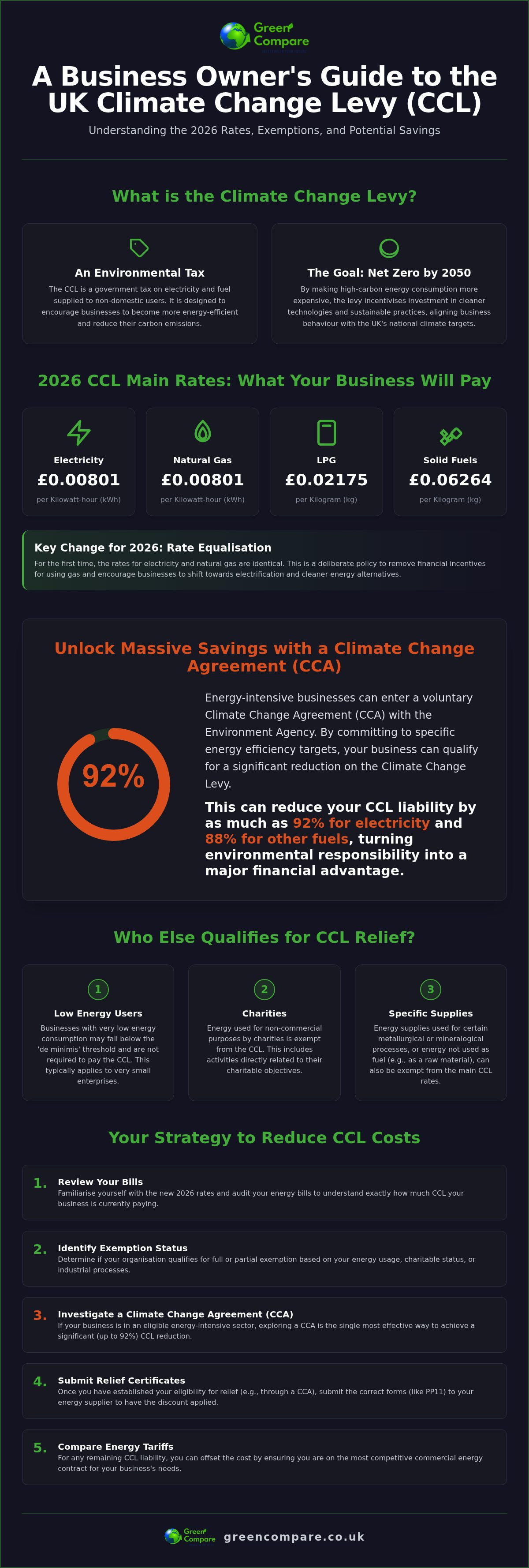
Not all energy sources are treated equally, but most commercial supplies fall under the levy's scope. In 2026, the government has equalised the rates for electricity and natural gas at £0.00801 per kWh. This is a significant shift designed to encourage businesses to move away from gas and towards electrification. Knowing these specific figures allows you to forecast your overheads with precision. The tax applies to the following taxable commodities:
- Electricity: This is the primary target for most UK offices and retail units. Even if you use green tariffs, the levy often still applies unless specific exemptions are met.
- Natural Gas: Used extensively for heating and industrial processes. The 2026 rate hike makes gas efficiency more critical than ever for your bottom line.
- LPG and Solid Fuels: Commodities like coal, lignite, and coke are common in rural or heavy manufacturing environments. These carry their own specific levy rates, with solid fuels sitting at £0.06264 per kg.
Most businesses find that electricity and gas make up the bulk of their levy liability. Because these costs are tied directly to your usage, every kilowatt-hour saved is money kept in your business. We're here to help you navigate these charges and find the most efficient path forward. By understanding what is the climate change levy and am i exempt, you can begin to strip away unnecessary costs and reinvest those funds into your company's future.
CCL Rates for 2026: What is the Cost to Your Business?
The financial landscape for UK businesses shifted on 1 April 2026. Following the Autumn Budget 2024 announcements, the government implemented a 3.4% increase across main levy rates. This change marks the end of a two-year freeze, making it vital for you to audit your utility spend with precision. If you've been searching for what is the climate change levy and am i exempt, the first step is understanding the specific figures now appearing on your invoices. These rates aren't just arbitrary numbers; they're a direct reflection of the UK's drive toward electrification and away from fossil fuel reliance.
2026 Main Rate breakdown
For the first time, we've seen a total equalisation between the two most common energy sources. The government has aligned the tax burden to ensure there is no financial incentive to choose gas over cleaner electric alternatives. According to the official Climate Change Levy rates, the current charges are:
- Electricity: £0.00801 per kWh.
- Natural Gas: £0.00801 per kWh.
- LPG (Liquefied Petroleum Gas): £0.02175 per kg.
- Other taxable solid fuels: £0.06264 per kg.
This equalisation means a business consuming 200,000 kWh of electricity will now face an annual CCL charge of £1,602. Because gas rates have risen to match electricity, heating-intensive industries will see a sharper rise in their overheads than in previous years. You can compare commercial energy rates today to find a more competitive base price that helps offset these mandatory tax increases.
How the CCL is calculated on your bill
Transparency is key to managing your cash flow. You'll find the CCL listed as a separate line item on your commercial energy invoice, usually situated near the VAT calculation. The formula used by your supplier is straightforward: your total kWh consumption for the period multiplied by the 2026 main rate. It's a transparent process, but it's one that rewards efficiency. Every unit of energy you don't use is a unit you don't pay tax on. It's also important to distinguish between these "Main Rates" and Carbon Price Support (CPS) rates. Whilst the Main Rate is paid by you, the consumer, CPS rates are paid by energy generators. However, these costs are often indirectly passed down through higher unit prices. By staying informed, you can move your business quickly from a position of uncertainty to one of strategic advantage.
Am I Exempt? Exploring CCL Exemptions and Exclusions
Identifying ways to lower your operational costs is a hallmark of a proactive business strategy. Whilst the 2026 rates apply to most, the system is designed with specific safety nets for smaller enterprises and certain sectors. If you're currently asking what is the climate change levy and am i exempt, the answer often depends on your daily consumption levels or the nature of your organisation. We believe in making these complex tax codes accessible, allowing you to reclaim your time and focus on what truly matters: growing your business. Not every company is required to pay the main rate, and uncovering these exclusions can provide immediate relief to your bottom line.
The "De Minimis" Rule for Small Users
Many micro-businesses and small offices pay the levy unnecessarily because they aren't aware of the "De Minimis" threshold. This rule is a vital exemption for low-energy users. If your average daily consumption is less than 33kWh of electricity or 145kWh of gas, you are automatically exempt from the CCL. This is equivalent to approximately 1,000kWh of electricity or 4,380kWh of gas per month. Check your meters. If your usage sits below these levels, your energy supplier should not be charging you the levy. We recommend auditing your recent bills immediately; if you've been charged whilst falling under these limits, you can often claim back overpayments from the last four years.
Charities and Domestic Use Exclusions
The government provides a 100% exclusion for energy used for non-business purposes. This applies primarily to registered charities and domestic settings. If you operate a residential home, student accommodation, or a self-catering holiday park, you shouldn't be paying the full commercial tax rate. Mixed-use premises, such as a shop with a flat above it, require a more nuanced approach. In these cases, you only pay the levy on the portion of energy used for business activities. There are several specific exemptions from the Climate Change Levy that cater to these unique setups, ensuring that social enterprises and residential providers aren't unfairly burdened by industrial tax rates.
Metallurgical and Mineralogical Exemptions
For those in heavy industry, the "Mineralogical and Metallurgical" exemption is a significant financial lever. This applies to energy-intensive processes where energy is used for more than just power or heat. Mineralogical processes include the manufacture of glass, ceramics, and cement. Metallurgical processes cover the smelting, forging, and casting of metals. If your business falls into these categories, you can apply for a 100% exemption on the energy used for these specific tasks. This isn't just a minor discount; it's a strategic advantage that supports the UK's manufacturing heritage whilst you transition toward more sustainable production methods. Taking the time to verify your eligibility today can secure your margins for years to come.
How to Claim Relief and Reduce Your CCL Liability
If you have confirmed your eligibility after asking what is the climate change levy and am i exempt, the next phase is taking decisive action. It isn't enough to simply qualify; you must proactively notify both HMRC and your energy supplier to stop the automatic charges. A useful shortcut to check your status is your VAT rate. If your business already qualifies for the reduced 5% VAT rate on energy, usually due to low "de minimis" usage or charitable status, you are often automatically exempt from the CCL. For larger enterprises, reducing this liability requires a more structured approach through specific government relief schemes. We're here to help you move quickly from identifying a potential saving to seeing that capital back in your accounts.
Climate Change Agreements (CCAs)
Industrial and energy-intensive sectors have a powerful tool at their disposal through Climate Change Agreements. These are voluntary arrangements made between UK industry sectors and the Environment Agency. By committing to specific energy efficiency targets, you unlock massive tax reductions that protect your margins. In 2026, these discounts are substantial. Eligible businesses can receive a 92% relief on electricity and an 89% relief on natural gas. Whilst these agreements require regular reporting and proof of efficiency gains, the financial reward is a significant driver for professional advancement and long-term sustainability. It's a partnership where your commitment to the environment directly fuels your business growth.
Filing the HMRC Paperwork
The process for claiming relief involves two primary documents that must be handled with precision. First, you need to complete Form PP10, which is the Climate Change Levy relief certificate. This form allows you to calculate the exact percentage of relief your business is entitled to based on your specific operations. Once this is finalised, you must submit Form PP11 to your energy supplier. This acts as the formal instruction to reduce or remove the levy from your future invoices. If you've only just discovered your eligibility, don't worry about past losses. You can typically claim back overpaid CCL for up to the last four years. This injection of recovered capital can be a vital boost for your next project. To ensure you're saving as much as possible across your entire utility spend, compare business gas and electricity rates today to secure the most competitive contract for your needs.
Securing these reliefs is a straightforward way to reduce your overheads without compromising on performance. We believe that every UK enterprise should have the tools to navigate these financial procedures with ease. By submitting the correct certificates and staying on top of your Climate Change Agreement targets, you turn a complex tax requirement into a streamlined strategy for business empowerment. The transition to a greener economy is a shared journey, and ensuring your business is financially lean is a critical part of that progress.
Optimising Your Business Overheads with Green Compare
Mastering your business overheads requires a holistic approach. Whilst understanding what is the climate change levy and am i exempt is a vital first step, it's only one piece of the puzzle. The 2026 rate increases are designed to nudge you toward greener choices, but these shouldn't come at the expense of your profitability. We view energy management as a journey of shared progress. By combining tax exemptions with a smarter procurement strategy, you can transform a mandatory cost into a narrative of professional advancement and sustainability. Every pound saved on tax is a pound that can be reinvested into your company's growth.
Switching to Offset Tax Increases
The 2026 market outlook suggests that stability is your greatest asset. With CCL rates for electricity and gas now equalised at £0.00801 per kWh, the total cost of your energy is more predictable than it has been in years. However, a predictable tax doesn't mean you should accept high unit rates. If your levy costs have risen, find a lower base rate to compensate. Securing a fixed contract now protects you from future fluctuations. Let us handle the bureaucracy of switching. We move you quickly from a problem to a solution, ensuring your time is spent on your core business goals whilst we manage the supplier transition for your business electricity and gas.
Funding Growth and Efficiency
True efficiency goes beyond just paying less; it's about using less. This is where strategic investment becomes a tool for long-term tax savings. You can use our business loans to fund essential green upgrades like solar panels, heat pumps, or LED lighting systems. These improvements do more than just lower your carbon footprint. They directly reduce the number of taxable kilowatt-hours on your bill, making the question of what is the climate change levy and am i exempt less critical because your exposure is fundamentally lower. It's a proactive way to build a resilient, future-proof enterprise that thrives in a low-carbon economy.
Our commitment to you is built on transparency, reliability, and speed. We aren't just a utility platform; we're a knowledgeable ally dedicated to your long-term development. Whether you are claiming 100% relief through metallurgical exemptions or simply looking for a more competitive electricity contract, we provide the expert guidance you need. Take control of your operational costs and join a community of forward-thinking UK businesses. Compare business energy prices today and start your journey toward a leaner, greener, and more profitable future.
Take Control of Your 2026 Energy Strategy
Navigating UK energy taxes doesn't have to be a drain on your resources. By now, you should have a clear understanding of what is the climate change levy and am i exempt, from the de minimis thresholds for small offices to the substantial reliefs offered by Climate Change Agreements. The 2026 rate equalisation at £0.00801 per kWh serves as a reminder that efficiency is no longer optional; it's a financial necessity for every growth-minded enterprise. We believe that your time is better spent leading your company than deciphering HMRC codes.
We're here to act as your trusted UK business finance partner, simplifying the process of reducing your overheads. Save time with our rapid comparison service and access competitive commercial gas and electricity rates that protect your margins. Our team is ready to help you move quickly from administrative stress to strategic progress. Compare business energy quotes and save on your 2026 overheads. Your business deserves a partner that values your time and shares your vision for a sustainable, profitable future. Let's build that momentum together.
Frequently Asked Questions
What is the current Climate Change Levy rate for 2026?
From 1 April 2026, the main rate for both electricity and natural gas is £0.00801 per kWh. This equalisation represents a 3.4% increase from previous years and aims to encourage electrification across UK enterprises. Other fuels carry different charges; LPG is set at £0.02175 per kg, whilst solid fuels like coal are taxed at £0.06264 per kg. These figures are typically updated annually to reflect national environmental targets.
How do I know if my business is exempt from the CCL?
Eligibility depends on your sector, the volume of energy you use, or your charitable status. If you are asking what is the climate change levy and am i exempt, start by checking your VAT rate. If you pay 5% VAT, you are likely already exempt. Specific industrial processes, such as glass manufacturing or metal smelting, also qualify for 100% exemptions under metallurgical or mineralogical rules that reward energy intensive production.
Do charities have to pay the Climate Change Levy?
Registered charities don't pay the levy on energy used for non-business activities. If your charity operates a commercial arm, such as a shop or a cafe, that specific portion of energy use may still be taxable. However, for residential care, community centres, or administrative offices used for charitable purposes, you are 100% excluded from these charges. You must provide a relief certificate to your supplier to stop the billing process.
Can I claim back overpaid Climate Change Levy charges?
You can claim back overpaid charges for up to the last four years. If you've recently discovered you meet the criteria for an exemption or the de minimis threshold, you should contact your energy supplier immediately. They can often facilitate a refund or credit your account for the historical overpayments. This process is a straightforward way to recover capital and improve your current cash flow without complex administrative hurdles.
What is the De Minimis limit for business energy?
The de minimis limit is a usage threshold that automatically exempts small businesses from the CCL. You qualify if your average daily consumption is less than 33kWh for electricity or 145kWh for gas. This is a vital safety net for small shops and offices. If your usage falls below these levels, you should also be paying the reduced 5% VAT rate on your commercial energy bills rather than the standard 20%.
How does a Climate Change Agreement (CCA) work?
A CCA is a voluntary agreement where your business commits to energy reduction targets in exchange for a massive tax discount. In 2026, these agreements can reduce your electricity levy by 92% and your gas levy by 89%. You must report your progress to the Environment Agency periodically to maintain your eligibility. It is an excellent way to align your financial goals with the UK's net zero ambitions while protecting your profit margins.
Is the CCL charged on renewable energy contracts?
The levy is generally charged on all commercial energy bills, regardless of whether you are on a green or renewable tariff. While the energy itself is cleaner, the tax is applied to the supply of taxable commodities to non-domestic users. To avoid the tax, you must meet specific exemption criteria or hold a CCA. Simply choosing a renewable supplier does not grant an automatic exemption from this statutory environmental tax.
Do I need to pay CCL if I run my business from home?
Most home based businesses are exempt because their energy usage is classified as domestic rather than commercial. If you use less than the de minimis threshold of 33kWh of electricity per day, you are automatically excluded from the levy. Even if you have a separate business meter, you won't pay the tax if your consumption remains below these daily limits, ensuring that micro enterprises aren't unfairly burdened by industrial taxes.