Business Energy Out of Contract Rates: The 2026 Guide to Protecting Your Profits

Did you know that UK SMEs on expired contracts are currently overpaying on their energy bills by as much as £3,000 every single year? It's a staggering figure that highlights the hidden cost of business energy out of contract rates, which are often 50% higher than negotiated fixed deals. You likely feel the frustration of watching hard-earned profits vanish into unexpectedly high variable rates whilst trying to decipher the complex difference between deemed and out of contract terminology.
We understand that your time is your most valuable asset. This guide helps you identify, compare, and escape these expensive traps whilst securing the most competitive prices for your enterprise. You deserve price certainty for the next 12 to 36 months and a streamlined path to growth. We'll walk you through the 2026 market landscape, explain how to bypass the loyalty tax, and show you how to lock in a better deal in minutes. Let's reclaim your budget and fuel your business's future together.
Key Takeaways
- Learn how to identify and escape expensive business energy out of contract rates that could be inflating your overheads by as much as 50%.
- Master the distinction between deemed and out of contract scenarios to ensure you are never caught off guard by supplier premiums.
- Discover how to secure price certainty for up to 36 months whilst switching from volatile variable rates to a stable fixed-term agreement.
- Follow a streamlined five-step process to transition your utility procurement, requiring only a recent bill and a current meter reading.
- Experience a stress-free procurement journey that prioritises your time and empowers your enterprise through rapid, expert-led market comparisons.
Understanding Business Energy Out of Contract Rates in 2026
Think of business energy out of contract rates as a default safety net for the supplier, not for you. When your fixed-term agreement expires without a new contract in place, your supplier moves you onto these variable prices. They aren't designed to be competitive. Instead, they are high-margin rates that reflect the supplier's risk in purchasing energy for a customer who could leave at any moment. In the current market, these rates have reached record highs, making them a significant threat to your annual profitability.
Suppliers justify these premiums by citing market volatility and the need for flexible procurement. Since April 2026, non-commodity charges have shifted the landscape significantly. For instance, Transmission Network Use of System (TNUoS) charges rose by over 60%, pushing standing charges to unprecedented levels. Understanding the broader context of UK energy policy helps explain why these costs are passed down so aggressively to the commercial sector. However, being on these rates is merely a temporary state. You can rectify it quickly with the right guidance and a proactive approach to your utility management.
Why Suppliers Move You to Variable Rates
Most fixed-term contracts transition into an "evergreen" or "rollover" status automatically. This shift happens when the renewal window closes without a new agreement being signed. It's a common result of administrative oversight in a busy office, but it effectively imposes a "loyalty tax" on your business. Unlike fixed contracts that lock you in for years, out of contract rates usually require no notice period to leave. This flexibility is your greatest asset. It allows you to move to a cheaper, more stable deal the moment you identify a better option. Don't let a missed deadline dictate your overheads for the rest of the year.
The Immediate Impact on Your Business Overheads
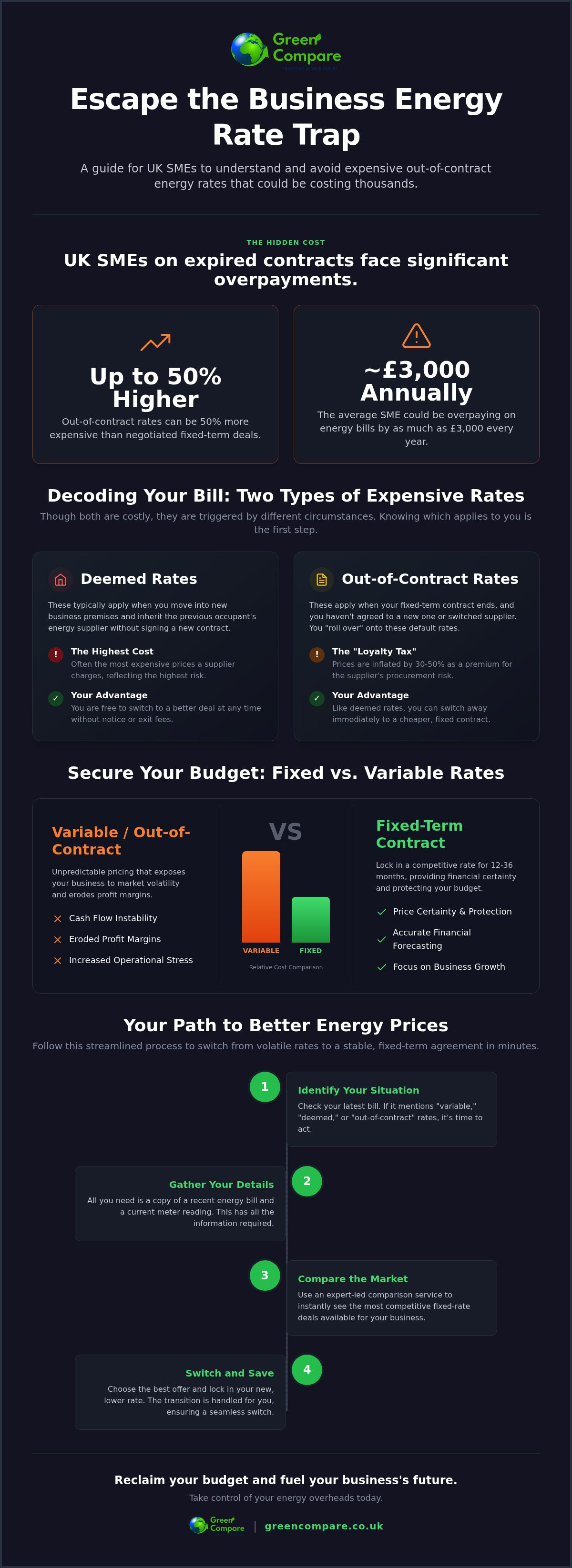
In 2026, businesses transitioning from a fixed contract to business energy out of contract rates face an immediate unit price increase of between 30% and 50%.
- Cash Flow Instability: Variable rates fluctuate monthly, making it impossible to produce accurate financial forecasts or budgets for your enterprise.
- Eroded Margins: Every extra penny spent on a kilowatt-hour is a penny taken directly from your bottom line, limiting your ability to reinvest in growth.
- Operational Stress: Managing high, unpredictable bills diverts your focus away from core business innovation and professional advancement.
Don't let variable pricing destabilise your project. Because you aren't tied to a long-term agreement whilst on these rates, you have the freedom to switch immediately. Use this window of flexibility to secure a fixed-rate deal that offers the protection and certainty your business needs to thrive. We can help you navigate this transition quickly, moving you from a position of vulnerability to one of total financial control.
Deemed vs Out of Contract: Decoding the Hidden Costs
Understanding the technicalities of your utility bill shouldn't require a law degree. However, many enterprises find themselves paying business energy out of contract rates simply because they didn't realise their agreement had shifted status. Whilst both deemed and out of contract rates result in higher costs, they are triggered by different events and carry distinct terms. Recognising which one you are on is the first step toward reclaiming your budget.
The Ofgem guidance on deemed contracts outlines the specific rules suppliers must follow when these scenarios arise. The silver lining for both situations is your freedom of movement. Because you haven't signed a new fixed-term agreement, you aren't bound by a long-term commitment. You can switch to a more competitive rate at any time without facing expensive exit fees. This flexibility allows you to request a rapid quote and move to a stable contract before the next billing cycle begins.
When Deemed Rates Apply
Deemed rates usually trigger during a "Move-In" scenario. If you take over a new office, shop, or warehouse, you automatically inherit the existing supplier. Since you haven't signed a formal agreement with them yet, they place you on deemed rates. These are often the most expensive prices a supplier charges. Identifying your current supplier quickly is vital. Check the serial number on your meter and contact the local network operator to find out who provides the supply. Don't wait for the first bill to arrive; by then, you've already overpaid for your initial month of trading.
When OOC Rates Trigger
Out of contract (OOC) rates apply the moment your existing fixed-term deal expires. If your contract ends at midnight, you are on OOC rates at 00:01 the next day. Suppliers rarely offer their most aggressive, profit-protecting prices automatically. They rely on administrative inertia to keep you on these high-margin variable rates. In 2026, regulatory standards require suppliers to provide clear notification of your contract's end date. Use this notice as a prompt to act. If you've already passed this date, your priority is speed. Transitioning back to a fixed deal ensures that your monthly overheads remain predictable and your profit margins stay protected against market spikes.
Whether you've just moved premises or your old deal has lapsed, the solution is the same. Act whilst you have the flexibility to choose. Transitioning to a structured procurement plan removes the stress of variable pricing and positions your business for long-term advancement.
Comparing Fixed Contracts vs Variable Out of Contract Rates
Choosing between a fixed-term agreement and remaining on business energy out of contract rates requires a clear framework for evaluation. You must weigh the immediate unit price against long-term stability and term length. For most UK enterprises, the cost of inaction is a direct hit to the bottom line. Whilst the flexibility of a variable rate sounds appealing, the financial data from July 2026 suggests it's a luxury few businesses can afford. A structured approach to procurement allows you to move from defensive cost-cutting to strategic financial planning.
The disparity in daily standing charges is often where the most significant "stealth costs" reside. On out of contract gas rates, for example, a business might face a daily standing charge of 338.0p. Compare this to a micro-business fixed-term rate where the charge is closer to 39.1p per day. This represents an annual difference of over £1,000 before you've even switched on a single light or heater. By securing a fixed contract, you eliminate these inflated daily fees and redirect those funds into your company's growth.
Beyond securing better rates, maintaining the hardware of your heating system is a vital part of energy efficiency; for instance, you can learn more about WellPlumbed to find professional plumbing and heating services in West Sussex that help keep your property running efficiently.
Price Certainty vs Market Volatility
Fixed-rate contracts act as a shield against global energy market shocks. In 2026, wholesale electricity costs fluctuate between £94 and £116 per MWh. A fixed deal locks your unit rate for 12, 24, or 36 months, providing 100% price certainty. This allows for precise financial forecasting; you'll have one less variable to worry about during your quarterly reviews. Conversely, business energy out of contract rates fluctuate monthly based on wholesale prices. This volatility makes it impossible to predict monthly overheads, often leading to cash flow stress when prices spike unexpectedly.
The Hidden Cost of Flexibility
Suppliers often frame variable rates as "flexible" because they lack exit fees. However, this flexibility comes with a massive premium. Businesses on these rates are currently paying 30% to 50% more than those on negotiated deals. Unless you plan to close your doors or move premises within the next 30 days, this "flexibility" is simply an unnecessary expense.
- The 12-Month Balance: Most SMEs find that a 1-year fixed deal offers the perfect middle ground between price protection and future flexibility.
- No-Exit-Fee Options: If you truly value the ability to switch, we can help you identify specific fixed-term contracts that offer lower exit penalties than the standard market average.
- Strategic Advancement: Moving to a fixed rate isn't just about saving money; it's about professional empowerment. It clears the administrative clutter, allowing you to focus on your core mission.
Don't let the fear of a long-term commitment keep you trapped in a high-cost variable cycle. Use the current market data to make an informed choice that prioritises your enterprise's profitability. Securing a competitive rate today ensures your business remains resilient and ready for the opportunities that lie ahead.
How to Switch and Secure Competitive Business Energy Prices
Transitioning away from expensive business energy out of contract rates is a straightforward process when you have the right partner. In 2026, the switching window has narrowed, meaning you can move from a variable rate to a fixed contract faster than ever before. Most suppliers now facilitate transfers in as little as five working days, provided your information is accurate and your account is clear of debt. We've refined this into a simple five-step path to protection.
- Step 1: Gather your data. You'll need a recent bill and a current meter reading. This ensures your quotes reflect your actual consumption patterns and prevents estimated billing errors.
- Step 2: Sign a Letter of Authority (LOA). This document empowers us to speak to suppliers on your behalf, handling the technical negotiations whilst you focus on running your business.
- Step 3: Market Comparison. We scan the 2026 market to identify deals that align with your specific usage and sustainability goals.
- Step 4: Review and Select. Choose the contract that offers the best balance of price certainty and term length for your enterprise.
- Step 5: Finalise and Switch. Once you sign, the new supplier handles the transition. There is no interruption to your power or gas supply during the move.
Finding Your Current Contract Details
Your energy bill contains two vital pieces of information: your MPAN (Meter Point Administration Number) for electricity and your MPRN (Meter Point Reference Number) for gas. These unique identifiers allow suppliers to locate your exact connection on the national grid. If you've recently moved premises and are on a deemed contract, your supplier's name will be on the most recent correspondence sent to the building. Before initiating a switch, check for any outstanding debt. Suppliers can legally block a transfer if there are unpaid arrears on the account, potentially keeping you trapped on high rates for longer than necessary.
Navigating the 2026 Energy Market
A competitive quote involves more than just a low unit rate. You must scrutinise the standing charges, which have become a larger portion of total costs following recent network charge increases. Some suppliers offer low unit rates but inflate the daily standing charge to compensate. We simplify this complexity by filtering the market to show you the total projected annual cost. This transparency allows you to make an informed decision based on the actual impact on your cash flow. You can start your comparison today to see how much your enterprise could save by moving to a structured agreement.
By acting now, you take control of your utility procurement. The process is designed to be stress-free, moving you quickly from the uncertainty of variable pricing to the security of a professional energy strategy. Don't let administrative complexity hold your business back from its next phase of advancement.
Efficiency First: How Green Compare Streamlines Your Energy Procurement
Managing commercial utilities shouldn't be a full-time job. At Green Compare, we've refined our procurement process to match the speed of modern business. We act as your proactive partner, helping you transition away from business energy out of contract rates with zero friction. Transitioning away from business energy out of contract rates is the fastest way to reclaim your operational budget and restore financial certainty. Our expert team understands that every minute spent on administration is a minute lost to innovation. That's why we've engineered a platform where you can receive a comprehensive, market-wide comparison in as little as 60 seconds.
This efficiency isn't just about speed; it's about empowerment. We provide the clarity you need to make decisive moves for your enterprise. By taking the weight of utility management off your shoulders, we allow you to focus on the visionary work that drives your sector forward. Since our founding in 2019, we've focused exclusively on the commercial sector, ensuring our advice is always grounded in the pragmatic realities of business finance.
Our 2026 Comparison Framework
Our national presence and established supplier relationships give us a unique advantage. We access exclusive rates that aren't always available directly to the public, ensuring you receive the most competitive prices in the 2026 market. Transparency is our core value. We don't just find you a better deal today; we commit to protecting you from future rollover traps. As your long-term ally, we'll alert you well before your new contract expires. This proactive approach ensures you never return to the high costs of variable pricing, keeping your overheads low and your margins protected whilst you grow.
Beyond Energy: Supporting Your Broader Business Growth
Reducing your energy overheads is a strategic win for your bottom line. Every pound saved on unit rates or standing charges is capital that you can reinvest into your team, your technology, or your sustainability goals. We view utility procurement as a vital step in a larger narrative of business empowerment and collective progress. When your administrative tasks are streamlined, your entire enterprise gains momentum.
Whilst we specialise in helping you switch to cost-effective gas and electricity contracts, our commitment to your growth goes further. We also facilitate business loans to help you bridge funding gaps or fuel your next big project. Our goal is to simplify your commercial finance, providing a suite of solutions that work in harmony to protect your profits and drive professional advancement. Don't let high variable rates hold your vision back any longer.
Secure your competitive business energy quote in minutes with Green Compare and join the thousands of UK enterprises already benefiting from our expert-led procurement service. Let's build a more efficient, profitable future for your business today.
Reclaiming Your Business Momentum
Protecting your enterprise's profit margins starts with eliminating unnecessary overheads. You now have the tools to identify expensive business energy out of contract rates and understand the vital distinction between deemed and expired agreements. Securing a fixed-term contract isn't just about reducing a bill; it's a strategic move that provides price certainty for up to 36 months. This stability allows you to forecast with confidence and reinvest your capital where it matters most.
Our 2026 comparison framework is designed to save you time and provide expert guidance on commercial gas and electricity procurement. Join the network of UK businesses that trust us to streamline their utility management and reduce operational stress. Compare business energy prices and escape out of contract rates today.
Take the first step toward a more efficient, empowered future for your business. We're ready to help you thrive.
Frequently Asked Questions
What is the difference between out of contract rates and deemed rates?
Deemed rates apply when you move into new premises without signing a formal agreement with the existing supplier. Out of contract rates trigger when your previous fixed-term deal expires and you haven't yet renewed or switched. Both are expensive variable options, but they are defined by how you entered the relationship with the supplier.
How much more expensive are business energy out of contract rates?
Businesses on business energy out of contract rates typically pay 30% to 50% more than those on negotiated fixed deals. In July 2026, electricity out of contract rates are approximately 40.0p per kWh, whilst gas rates are around 12.0p per kWh. These premiums act as a heavy financial penalty for administrative delay.
Do I need to give notice to leave an out of contract business energy rate?
No notice period is usually required to leave these rates. Since you aren't bound by a fixed-term agreement, you have the total freedom to switch to a competitive deal immediately. This flexibility is your greatest tool for reclaiming your budget; use it before your next high-cost billing cycle begins.
Can my supplier refuse to let me switch if I am out of contract?
Your supplier can only block a switch if you have outstanding debt on your account. If your payments are up to date, they cannot legally prevent you from moving to a more cost-effective provider. It's vital to clear any arrears before starting the procurement process to ensure your transition is rapid and successful.
How long does it take to switch from out of contract rates to a fixed deal in 2026?
Most switches are now completed in as little as five working days. The 2026 energy market has become significantly more streamlined, allowing for faster transfers between suppliers than in previous years. We handle the technical negotiations to ensure you move from high variable pricing to price certainty without any unnecessary delay.
Will my energy supply be interrupted during the switch?
No, your gas and electricity supply will never be interrupted during the switching process. The transition is purely administrative, meaning the same wires and pipes continue to deliver your energy. The only difference you'll experience is a more competitive unit rate and a different name on your monthly invoice.
What information do I need to get a new business energy quote?
You only need a recent energy bill and a current meter reading to receive an accurate quote. Your bill contains your MPAN and MPRN numbers, which are essential for identifying your meters on the national grid. Providing a fresh reading ensures your new contract is based on real consumption rather than supplier estimates.
Are out of contract rates ever cheaper than fixed-rate contracts?
Out of contract rates are almost never cheaper than a negotiated fixed-term deal. Suppliers price these variable rates at a significant premium to protect themselves against market volatility. In 2026, the gap between fixed and business energy out of contract rates remains wide, making variable pricing a poor choice for any profit-focused enterprise.